
AI Overviews - Part 3: Re-evaluating Your SEO Strategy for the AI Age
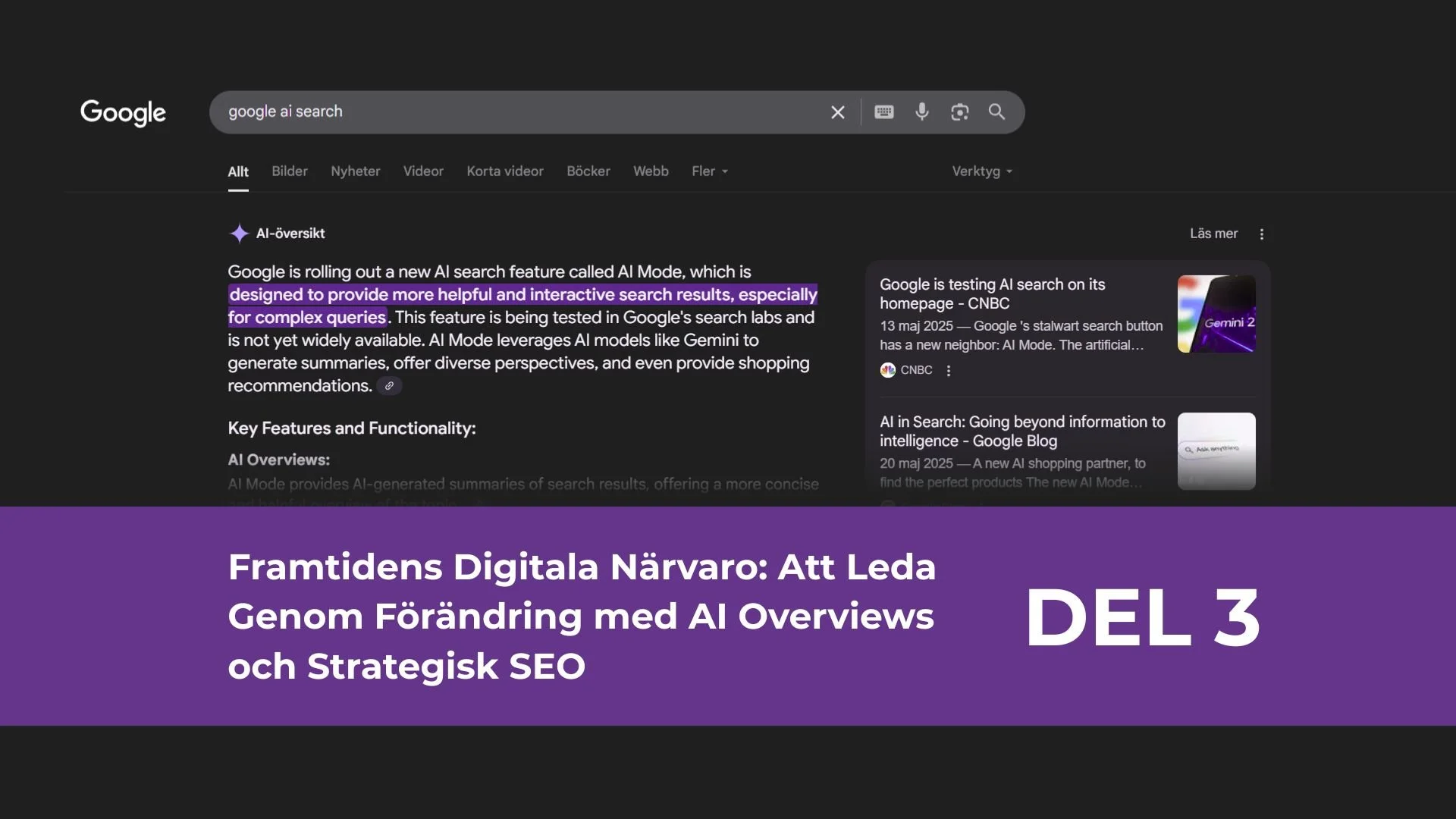
In the first two parts of this article series, we introduced Google's AI Overviews (AIO) and its technical foundations, and took a deep dive into how this new search feature affects website traffic and user behavior. We have seen that the landscape is changing fundamentally, with a trend towards "zero-click searches" and a shift from just chasing clicks to building authority and visibility in AI-generated answers.
To successfully navigate this new era, it's not enough to just understand the changes – you must actively adapt your strategies. In this third part, we focus on how you need to re-evaluate and update your fundamental SEO principles not just to survive, but to thrive in the age of AI search. At Multiproduktion, we know that a strong digital presence is built on a solid foundation, and understanding these new SEO imperatives is crucial for your message, whether it's text or moving images, to reach its audience.
Keyword Strategy Redefined: From Exact Match to Semantic Understanding
The traditional focus on exact matching of short, high-volume search terms is becoming less effective. The AI systems behind AI Overviews are significantly more sophisticated; they understand natural language, context, and the semantic meaning behind a search query, rather than just matching individual words (p. 6).
This implies a shift:
Long-tail keywords become more important: Longer, more specific, and conversational search phrases (three to five words or more) often reflect a clearer and more complex user intent. AI Overviews are designed to handle this type of question (p. 6). Estimates show that over 70% of all searches are made up of long-tail phrases.
Semantic keyword research and Topic Clusters: Instead of optimizing individual pages for isolated keywords, it's now about covering a topic comprehensively through a network of related content – so-called topic clusters. This signals thematic authority to both search engines and AI systems (p. 6).
From "keyword strategy" to "question strategy": The core lies in understanding the underlying questions, problems, and information needs that users have, and creating content that addresses their entire needs spectrum (p. 6).
For us at Multiproduktion, this is clear: it's about creating content that provides exhaustive answers to the questions that the target audience actually asks. A well-produced explainer video or an animated infographic can effectively answer complex long-tail questions and thus become a valuable part of a topic cluster.
Decoding User Intention: Beyond Broad Categories to Hyper-Specificity
Understanding user intention has always been central to SEO, but with the advent of AI, it becomes even more important to go beyond broad categories (information search, transactional search, etc.) and strive to understand hyper-specific intention (page 7).
AI-driven search engines are better at understanding nuanced needs. For your content to have a chance to rank and be cited in AI Overviews, it must be precisely tailored to meet these specific needs (page 7). A "one-size-fits-all" strategy works increasingly poorly. Generic content that tries to cover too many different needs at once risks failing to engage or be chosen by the AI (page 7).
This requires in-depth target audience analysis and a thorough mapping of the customer journey. Create a portfolio of content pieces, where each piece is tailored to a niche question, a specific problem, or a defined step in the user's decision-making process (p. 7).
E-E-A-T as a Cornerstone: Building Trust and Authority for AI and Users
The principles of E-E-A-T (Experience, Expertise, Authoritativeness, Trustworthiness) have long been important, but in the AI age, they become crucial (p. 7).
AI Overviews strives to deliver accurate and reliable answers and will therefore prioritize information from sources that exhibit strong E-E-A-T signals (page 7). This means that the content must be fact-checked, cite credible sources, clearly show the author's or organization's expertise, and that the website itself is secure and trustworthy (page 7-8). Being able to show first-hand experience ("Experience") has become an increasingly important component (page 8).
Investments in building real expertise, transparently displaying authorship and references, and ensuring a technically sound website are directly linked to the possibility of achieving visibility in AI Overviews (page 8). It's about building a digital reputation that AI can verify and trust.
Here at Multiproduktion, we see a great potential for our customers. By creating high-quality films and animations that clearly demonstrate your expertise, showcase case studies and customer references, and present your experience in a credible way, you build E-E-A-T signals that are valuable for both human visitors and AI systems.
Technical SEO Imperatives: Ensuring AI Can Find, Understand, and Favor Your Content
Basic technical SEO remains critical. Fast loading times, mobile-friendliness, HTTPS, clear navigation, and good crawlability and indexability are fundamental (page 8).
One aspect that becomes exceptionally important in the context of AI Overviews is structured data (Schema Markup) (page 8). Structured data is code that gives search engines and AI systems explicit information about the content's meaning and context. This helps the AI better understand the content and increases the chance that it is included in AI Overviews (page 8). Relevant schema types include FAQPage, HowTo, Article, Product, LocalBusiness, and Organization (page 8).
A simple and logical website structure with thoughtful internal linking also helps AI systems understand the relationships between different content pieces and build thematic authority (page 8). Technical SEO is now just as much about making content accessible and understandable for AI systems as it is for traditional search engine crawlers (page 8).
The Changing Role of Link Building and Brand Mentions
Links are still important. Quality backlinks from authoritative and relevant websites signal credibility, and Google still uses links as a factor in its core ranking systems, which form the basis for AI Overviews (page 8).
Beyond direct links, brand mentions on third-party sites, in forums (like Reddit, Quora), social media, and traditional media are becoming increasingly important as a signal of authority and credibility, not just for users but also for AI systems (page 9). Positive mentions in relevant contexts can significantly strengthen your E-E-A-T profile. Google can use information from these sources when generating AI Overviews, which can lead to your brand being highlighted in the AI response (page 9).
Auktoritetssignalerna breddas. Det handlar inte längre enbart om antalet och kvaliteten på direkta backlinks, utan om en mer holistisk syn på ert varumärkes närvaro, rykte och anseende online (sid. 9). Strategier som digital PR, aktiv närvaro i online-communities och uppmuntran av kundrecensioner blir viktigare (sid. 9).
Conclusion
Adapting your SEO strategy for the AI age is about shifting focus from optimizing solely for algorithms to optimizing for user problems and positioning yourself as the most reliable source within your niche. It requires a deeper understanding of semantics and user intent, a commitment to E-E-A-T, an updated technical foundation with a focus on structured data, and a broader perspective on authority building that includes brand mentions.
At Multiproduktion, we are convinced that high-quality, strategically designed content - including powerful moving images - is the key to succeeding in this new landscape. By combining a solid technical SEO foundation with content that builds E-E-A-T and addresses hyper-specific user needs, you increase your chances of becoming the authority that both users and AI systems trust and cite.
What Does This Mean for Your Content Creation? (Teaser for Article 4)
Now that we've gone through how you need to re-evaluate your SEO fundamentals, the next natural step is to look at how you concretely create content that is not only technically optimized, but actually thrives in the age of AI Overviews. In the next part of this series, we will explore how you produce high-quality, in-depth, and original content, how you structure it for AI citations, and how you create unique value that AI can't easily summarize. Stay tuned for part 4!
FAQ - Frequently Asked Questions
-
AI systems understand semantics and context, not just exact word matches. They can interpret complex and conversational search queries, which shifts the focus to understanding the user's underlying needs rather than just optimizing for individual terms
-
E-E-A-T stands for Experience, Expertise, Authoritativeness, Trustworthiness. It is crucial because AI Overviews prioritize information from sources that exhibit strong signals in these areas to ensure that the generated responses are accurate and reliable.
-
Structured data (Schema Markup) provides AI systems with explicit information about the meaning and context of your content. This makes it easier for AI to interpret the content correctly and increases the likelihood that it will be included in AI Overviews or other expanded search results.
-
Yes, high-quality backlinks are still an important signal for authority and credibility. But brand mentions on third-party sites, in forums, and on social media are becoming increasingly important as complementary authority signals for AI systems.
-
It requires in-depth target audience analysis, keyword research focusing on long-tail questions and conversational searches, as well as analysis of data from tools like "People Also Ask" in Google search results.